
A Tesla Hit a Woman in Her Living Room. The Driver Says Autopilot Did It.
On June 20, 2026, a Tesla Model 3 tore through the brick facade of a Katy, Texas home at an estimated 60 to 70 miles per hour, killing Martha Avila…
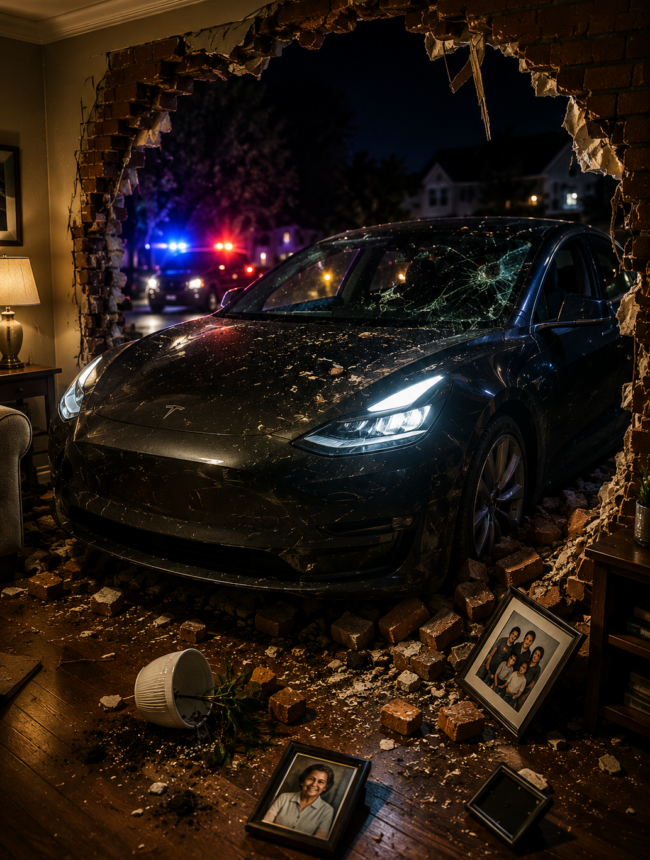
On June 20, 2026, a Tesla Model 3 tore through the brick facade of a Katy, Texas home at an estimated 60 to 70 miles per hour, killing Martha Avila Mantilla, 76, who was standing in the front room.
The driver told Harris County deputies the vehicle was on Autopilot at the time of impact. That claim now lands inside NHTSA’s most serious federal investigation of Tesla’s driver-assistance technology — a probe covering 3.2 million vehicles that is one step away from a mandatory recall demand.
Martha Avila Mantilla had lived with her daughter’s family since her first grandchild was born. She was in good health, on no medication. On a Friday evening, a car came through the wall.
Surveillance Video Shows the Tesla Autopilot Crash
According to reporting by KPRC 2 and ABC13, surveillance footage captured the Tesla Model 3 accelerating down Rose Hollow Lane before striking a curb and driving through the two-story brick facade of a house on Blooming Park Lane. A witness at a nearby birthday party told investigators the car appeared to be traveling at 60 to 70 miles per hour.
The Harris County Sheriff’s Office confirmed that driver Michael Butler, 44, failed to maintain a single lane, left the roadway, and did not make a required right turn before striking the residence at high speed. Avila Mantilla was airlifted by Life Flight to Memorial Hermann hospital, where she was pronounced dead.
Butler was transported by ambulance and was cooperative with investigators. No signs of intoxication were found, and no charges had been filed as of June 22, 2026.
The home — occupied by two parents, three young children, and Avila Mantilla — sustained damage so severe it was rendered uninhabitable.
What the Driver Said — and What Investigators Must Now Prove
According to the Harris County Constable Precinct 5, Butler told deputies the Tesla was on Autopilot at the time of the crash. The Harris County Sheriff’s Office separately confirmed that Butler told investigators an automated driving-assistance system was engaged.
Investigators are now examining the vehicle’s event data recorder and onboard logs to verify whether that system was active, at what speed, and whether any driver input was recorded in the seconds before impact.
Sgt. Alex Turman, an accident investigator with the Harris County Sheriff’s Office, told Covering Katy News that the cause of the crash remained undetermined.
“We’re digging into that. That’s a line of investigation for sure,” Turman said when asked whether automated driving features were in use.
Complicating matters further: Tesla discontinued Autopilot as a product for new vehicles in the U.S. and Canada in January 2026 — under pressure. A California administrative law judge had ruled that the term violated state consumer protection law in December 2025. But millions of existing Tesla vehicles still carry the software.
If the Model 3 involved in the crash was purchased before January 2026, Autopilot could have been active on the vehicle even after Tesla stopped selling it as a feature. Investigators have not specified the vehicle’s model year.
The Branding Was Already Ruled Misleading
The question of what Tesla’s product names led drivers to believe is no longer theoretical. In December 2025, a California administrative law judge ruled that Tesla’s use of “Autopilot” violated state consumer protection law and that “Full Self-Driving” was, in the judge’s words, “actually, unambiguously false.”
To avoid a 30-day suspension of its dealer and manufacturer licenses, Tesla dropped the Autopilot name from its marketing and discontinued the product for new vehicles — then filed a lawsuit against the California Department of Motor Vehicles in February 2026 seeking to reverse the ruling. That sequence of events is documented in reporting by Electrek covering Tesla’s February 2026 agreement with California regulators.
In August 2025, a Miami federal jury awarded $243 million in a wrongful death case stemming from a 2019 Autopilot crash in Key Largo, Florida, that killed 22-year-old Naibel Benavides Leon. The jury found Tesla 33% liable, citing the system’s design and Tesla’s marketing as contributing factors — a verdict documented in case commentary on the Benavides v. Tesla proceedings.
In February 2026, U.S. District Judge Beth Bloom rejected Tesla’s bid to overturn that ruling. According to Electrek’s reporting on the February 2026 decision, Judge Bloom found that “evidence admitted at trial more than supports the jury verdict.” Tesla is pursuing an appeal to the Eleventh Circuit.
The engineering reason these rulings matter is specific. Tesla’s Autopilot and FSD rely on a camera-only architecture — no radar, no lidar. The system processes the road through 8 cameras and a neural network with no sensor backup for conditions in which cameras degrade.
Competitors including Waymo use combinations of cameras, lidar units, and radar arrays, creating overlapping sensor coverage so that failure in any single sensor does not blind the system. That design difference defines the outer boundary of what Tesla’s system can reliably perceive.
Why 3.2 Million Vehicles Are Already Under Federal Scrutiny
On March 18, 2026, NHTSA opened Engineering Analysis EA26002, upgrading a Preliminary Evaluation it had launched in October 2024. According to the NHTSA Engineering Analysis opening report, the probe covers an estimated 3,203,754 vehicles, including 2017-through-2026 Model 3 sedans of the kind involved in the Katy crash.
The NHTSA report focuses on a specific failure mode: Tesla’s degradation detection system does not reliably identify when FSD cameras are blinded by common road conditions such as sun glare, fog, or airborne dust, and does not warn the driver in time to respond.
In the 9 crashes NHTSA reviewed, the degradation detection system either failed to detect a degraded state or failed to alert the driver with adequate time to react. In each of those crashes, FSD also lost track of or never detected a lead vehicle in its path. NHTSA further determined that Tesla may have under-reported related crashes because internal data and labeling limitations prevented the company from uniformly identifying crash events where the system was engaged.
An Engineering Analysis is the final tier of NHTSA’s Office of Defects Investigation before the agency can issue an influence letter, demand a mandatory recall, or close the case. As reported by Electrek, NHTSA typically completes an Engineering Analysis within 12 to 18 months of opening. EA26002 was opened March 18, 2026, putting the expected completion window around September 2027.
A separate NHTSA probe — PE25012 — covers approximately 2.88 million Tesla vehicles and focuses on FSD executing maneuvers that constitute traffic violations: running red lights, crossing into opposing lanes. According to Electrek’s reporting on that investigation, Tesla received multiple deadline extensions from NHTSA in producing data for PE25012. The 80 documented instances cataloged under that probe and the extension history are detailed in Electrek’s February 2026 coverage of the investigation.
The Katy crash does not appear to involve the specific low-visibility failure mode at the center of EA26002 — the crash occurred in the evening on a residential street, not in fog or sun glare. But a driver claiming a Tesla drove itself into a house on a residential street is a concrete, fatal illustration of the gap between what Level 2 branding implies and what Level 2 systems actually require.
The Supervision Trap Nobody Warned Buyers About
Under SAE’s automation classification framework, Tesla’s Autopilot and FSD are Level 2 systems. The driver is legally responsible for everything the vehicle does at all times — with or without a warning from the system. That legal reality is not what the product names communicated to most buyers, and it is exactly what regulators and juries are now examining.
Raffi Krikorian, who led Uber’s self-driving division before experiencing a crash in his own Tesla with his children in the back seat, has described what researchers call the “supervision trap,” as reported by TechTimes. Tesla’s FSD performs well enough, often enough, that drivers become conditioned to disengage attention.
The danger is not that the system is always unreliable — it is that the system is usually reliable, which trains a driver to stop expecting failure. When failure comes, the driver is not ready to intervene.
This is the structural challenge that neither a software update nor a branding change can fully resolve without moving to a system that either genuinely does not require driver supervision — Level 3 or higher — or genuinely cannot operate in a way that cultivates false confidence. Tesla’s response to the California ruling was to sue the regulator who said so.
Tesla has not responded to requests for comment on the Katy crash. The company dissolved its media relations team years ago and does not typically respond to press inquiries.
What Tesla Owners Should Do Right Now
- Check whether your vehicle is covered by EA26002. The probe covers 2017–2026 Model 3, Model S, Model X, and Model Y vehicles equipped with FSD. Enter your VIN at nhtsa.gov to check your vehicle’s recall and investigation status.
- Report unexpected system behavior immediately. If your Tesla’s Autopilot or FSD fails to brake, drifts lanes, or ignores obstacles, file a complaint with NHTSA’s Vehicle Safety Hotline at safercar.gov or 1-888-327-4236. These reports feed directly into active investigations including EA26002 and PE25012.
- If you were injured in a crash involving Autopilot or FSD, preserve all vehicle data immediately — Tesla’s onboard logs have retention windows that create time pressure for investigators and potential litigants. The $243 million Florida verdict established that product liability claims against Tesla are winnable.
- Track the federal investigation. NHTSA’s EA26002 is expected to conclude around September 2027. The agency will either close it, request voluntary recall action, or demand a mandatory recall across the 3.2-million-vehicle population. No recall has been issued as of June 22, 2026.
Martha Avila Mantilla was standing in her own home. The investigation is open. The vehicles are still on the road.
If Tesla’s Autopilot or Full Self-Driving caused a crash or behaved dangerously, report it to NHTSA at safercar.gov — or tell us what happened.
 Written by: Companies Behaving Badly
The team behind it all.
Been harmed by corporate negligence? Our legal partners can help you understand your rights and pursue justice.