

Meta Saw the Teen Harm Data. Kept the Infinite Scroll Anyway.
On July 10, 2026, the European Commission issued preliminary findings that Meta violated the Digital Services Act by engineering Facebook and Instagram to be compulsive — through infinite scroll, autoplay…
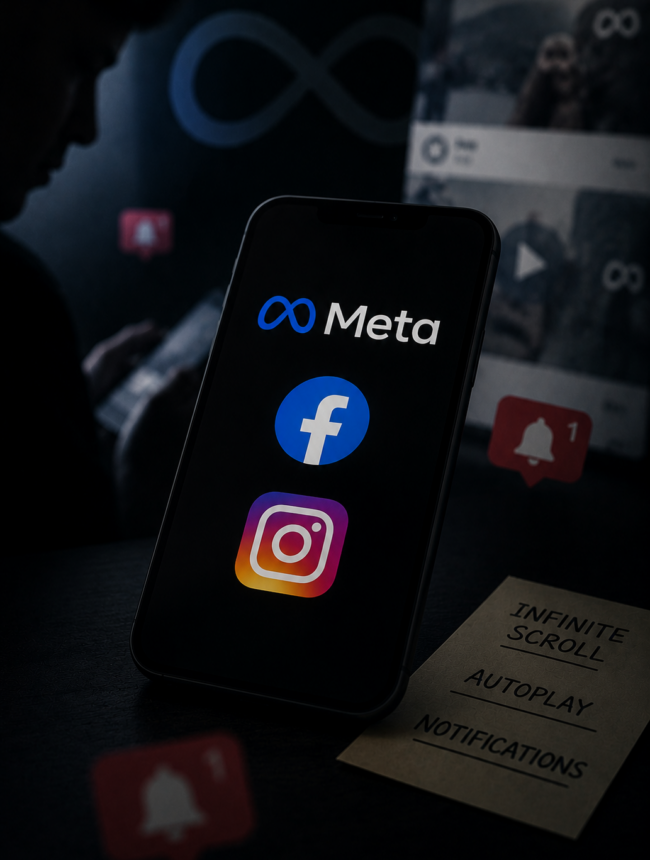
On July 10, 2026, the European Commission issued preliminary findings that Meta violated the Digital Services Act by engineering Facebook and Instagram to be compulsive — through infinite scroll, autoplay video, push notifications, and algorithmic amplification designed to maximize time-on-platform.
Meta faces a fine of up to $12 billion. The features remain on by default for every user, including children, right now. If you have ever picked up your phone to check one notification and looked up forty minutes later, you were not weak. You were the product working as designed.
The EU’s enforcement action — one of the most significant under the Digital Services Act since the law took effect — names the specific mechanics Meta built to keep users scrolling past any natural stopping point. These are not side effects of a social platform. According to the Commission’s preliminary findings, they are the platform’s core revenue engine, and regulators in Brussels are now treating them as a legal violation rather than a product philosophy.
Predictably, Meta disagrees. Also predictably, nothing has changed yet. That’s why they made our Worst Social Media Companies list.
The Features the EU Wants Gone by Default
The Commission’s preliminary findings target four specific design choices that regulators say push users into what they called “autopilot mode”:
- Infinite scroll — no natural endpoint to a feed, removing the moment of friction that would otherwise prompt a user to stop
- Autoplay video — content begins playing before a user actively chooses to watch, extending sessions without conscious decision
- Push notifications — alerts engineered to pull users back into the app at moments of disengagement
- Engagement-optimized recommendations — algorithmic surfacing of content calibrated to maximize time-on-platform, not user satisfaction or wellbeing
According to Euronews reporting on the Commission’s findings, Meta disregarded its own internal data on how these features affect teenage nighttime usage patterns. The company’s time-management tools — the ones Meta points to as evidence of responsible design — were deemed easily ignored and not meaningfully effective at reducing use.
Parental controls, the Commission found, only work for technically skilled parents with enough time to configure them correctly. For everyone else, the defaults win.
That last point matters. Defaults are not neutral. When a company sets infinite scroll as the default and buries the opt-out in settings, it is making an active choice about whose interests the product serves.
A $12 Billion Number That Investors Aren’t Worried About (Yet)
The fine ceiling under the Digital Services Act is 6% of global annual turnover. Based on Meta’s 2025 revenue of approximately $201 billion — that translates to roughly $12 billion, by far the largest DSA enforcement action ever threatened.
For context, the EU’s previous DSA penalties included a €120 million fine against X (formerly Twitter) and a €200 million penalty against Temu, both cited in Euronews reporting on the Commission’s findings. The potential Meta fine would dwarf both combined.
And yet: According to financial data reported alongside the enforcement coverage, Meta shares closed on July 11, 2026 at $669.21, up nearly 6% on the day, with a market capitalization of approximately $1.7 trillion. The stock was up roughly 12.5% over the prior five trading days.
Investors are not pricing in material financial risk from this probe — which tells you something about how seriously the market expects the fine to actually land at its ceiling.
The findings are preliminary. Meta will submit a formal response before the Commission reaches a final decision, and the company is not required to change anything until a final ruling is issued.
Meta said the findings “don’t accurately take into account the significant steps we’ve taken to protect teens.”
The industry’s argument has some surface logic — Meta has introduced teen accounts, screen-time reminders, and content filters. What that argument misses is that the Commission’s objection isn’t to the existence of optional safeguards. It’s to the default state of the product for every user who never touches those settings, which is most of them.
Why This Keeps Happening — and Why the U.S. Is Watching From the Sidelines
Meta’s history with regulators is not a story of isolated missteps. It is a pattern:
- 2019 — $5 billion FTC settlement over Cambridge Analytica privacy violations
- 2022 — €405 million Irish Data Protection Commission fine over children’s data handling on Instagram
- 2023 — €1.2 billion Irish DPC fine for illegal EU-US data transfers, the largest GDPR penalty ever issued at the time
- 2026 — European Commission DSA preliminary findings over addictive design, potential $12 billion fine
Each fine has been absorbed. Each time, the company’s revenue has grown faster than the penalties. The incentive structure is not complicated: Meta makes money when users spend more time on its platforms, because more time means more ad impressions.
Infinite scroll and autoplay are not bugs in that model — they are load-bearing features. Removing them by default would reduce engagement metrics, which would reduce ad revenue, which is why the company built them in the first place and why it takes a regulator with legal authority to compel the change.
The EU’s current enforcement action is, in part, a direct institutional response to documented evidence that Meta was aware its platform design was harming users — particularly teenagers — and continued optimizing for engagement regardless. The company saw the data. It kept the features.
What About for Americans?
American users are in a different position. The FTC has no equivalent authority under current U.S. law to mandate changes to platform design features. There is no US equivalent of the Digital Services Act.
The FTC can fine companies for deceptive practices, but “we built a product that is very good at capturing your attention” has not been successfully prosecuted as deception in US courts.
The result is that EU users may soon have a version of Instagram with friction built in by law, while U.S. users — and U.S. children — continue using the engagement-maximized default.
What You Can Do Right Now
The settings exist. They are buried, but they exist. Here is where to find them:
- Switch to a chronological feed on Instagram — go to Settings > Following & Favorites. This removes algorithmic amplification from your main feed. You will see posts in order, not in the order Meta’s system calculated would keep you scrolling longest.
- Disable autoplay on Facebook and Instagram — on Instagram, go to Settings > Accessibility > Videos and turn off autoplay. On Facebook, go to Settings & Privacy > Settings > Media > Autoplay.
- Turn off non-essential push notifications — on both platforms, go to Settings > Notifications and disable everything except direct messages from people you actually want to hear from. Every other notification is a re-engagement trigger.
- If you are in the EU, file a complaint with your national Digital Services Coordinator — each EU member state has a designated authority responsible for DSA enforcement. Complaints from users documenting harm from addictive design features are relevant to the ongoing enforcement action against Meta.
- File an FTC complaint if you are in the U.S. — while the FTC cannot currently mandate design changes, documented consumer complaints about harmful platform practices build the evidentiary record for future enforcement. File at reportfraud.ftc.gov.
- If you have a child using Instagram or Facebook — the Commission’s findings specifically noted that parental controls are only effective for technically skilled parents who configure them correctly. Walk through the teen account settings manually. Do not assume the defaults protect your kid.
Contact us now if you or a loved one has suffered harm from social media addiction. We can help you understand your options and fight back.
 Written by: Companies Behaving Badly
The team behind it all.
Been harmed by corporate negligence? Our legal partners can help you understand your rights and pursue justice.