
Amazon Zoox Robotaxis Recalled Over Not Recognizing an Active Fire Scene
On June 20, an unoccupied Zoox robotaxi drove into an active fire scene obscured by thick smoke — because the vehicle’s software couldn’t recognize it as a hazard. On July…
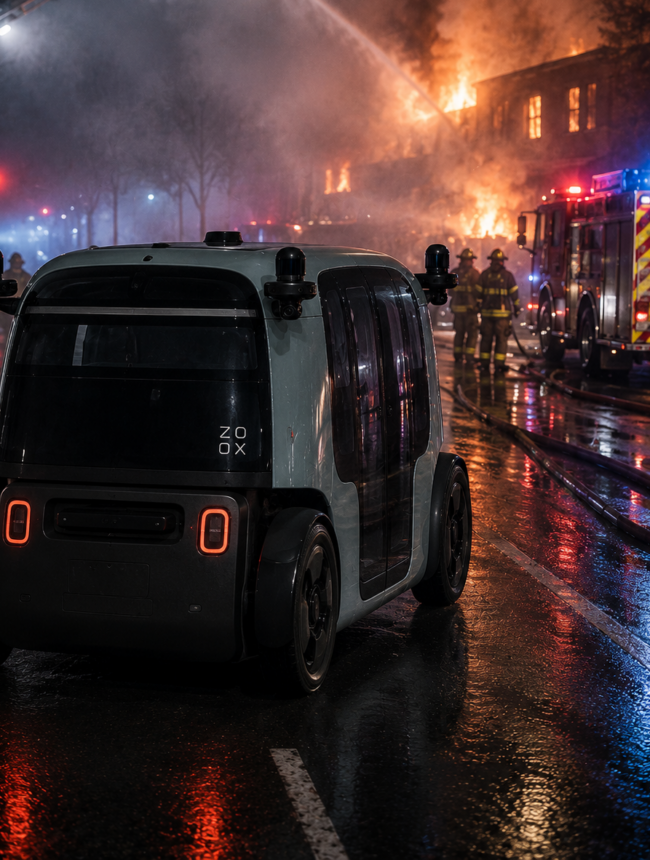
On June 20, an unoccupied Zoox robotaxi drove into an active fire scene obscured by thick smoke — because the vehicle’s software couldn’t recognize it as a hazard. On July 17, the entire 105-vehicle fleet of Zoox robotaxis was recalled due to the incident. The software patch has since been pushed over the air to every Zoox robotaxi in the U.S.
Zoox’s robotaxi entered the active fire scene before first responders had placed traffic cones or physical barriers. The car couldn’t see the emergency. Not because of the smoke — but because nobody had programmed it to understand that smoke means emergency.
Without those cues, the onboard sensors and driving algorithms didn’t register the danger. The vehicle braked abruptly inside the scene and sat there — in the middle of an active emergency operation — until a remote human operator manually reversed it out.
But if you’ve ever watched a fire crew work and thought about what happens when a two-ton autonomous vehicle parks itself in the middle of it, you understand why regulators didn’t find this charming.
This Isn’t the First Zoox Recall
According to the NHTSA recall report, the smoke-detection flaw affected 100% of Zoox’s active fleet — every vehicle deployed since April 2026. The same filing documents that the software vulnerability created real risk of collisions and interference with first responders during active emergencies.
This is also, notably, not Zoox’s first time in this particular chair. The NHTSA recall report references prior compliance reviews and recalls involving unexpected braking behaviors and errors in predicting how surrounding vehicles would move.
The agency has been monitoring the autonomous vehicle sector closely, and the pattern of self-driving cars creating problems at emergency scenes has drawn specific regulatory attention across the industry — not just at Zoox.
The Fix — and the Larger Problem It Doesn’t Fix
The good news: This was an over-the-air software update. No vehicles needed to be physically pulled from service. The patch improves emergency scene recognition and navigation under low-visibility conditions. According to the NHTSA recall report, it has been successfully deployed to all 105 vehicles in the fleet.
The less reassuring news is the sequence of events that got us here:
- Software ships without the ability to recognize an active fire scene as a hazard
- Vehicle drives into said fire scene
- Incident is reported
- Recall is issued
- Fix is deployed
That is not a quality-control pipeline. That is a field test with extra steps. Zoox’s robotaxis are not available to the public — this is an internal test fleet, which matters.
But the industry is moving fast toward commercial deployment. The gap between “we fixed it after an incident” and “we caught it before deployment” is exactly the gap regulators are supposed to close.
Amazon, which owns Zoox, is not a company that lacks resources for pre-deployment testing. The question of why a vehicle operating near emergency scenes couldn’t identify one is something Zoox hasn’t fully answered in public.
To be fair to the physics: Thick smoke is genuinely hard for sensors to read, and no autonomous system handles every edge case before it encounters one in the real world. But “active fire scene with no cones yet” is not a particularly exotic scenario for a vehicle operating on public roads. It’s the kind of thing you’d hope ended up on the test checklist somewhere before June 20th.
If you witnessed a Zoox autonomous vehicle behaving unsafely near an emergency scene, report it to NHTSA at safercar.gov — or tell us about it.
 Written by: Companies Behaving Badly
The team behind it all.
Been harmed by corporate negligence? Our legal partners can help you understand your rights and pursue justice.