

Allstate Had a Name for It: ‘Disaster Payment Minimization Scheme’
On July 7, Oklahoma Attorney General Gentner Drummond filed a lawsuit against Allstate Insurance Company, alleging the insurer ran a coordinated internal program to deny or underpay legitimate wind and…
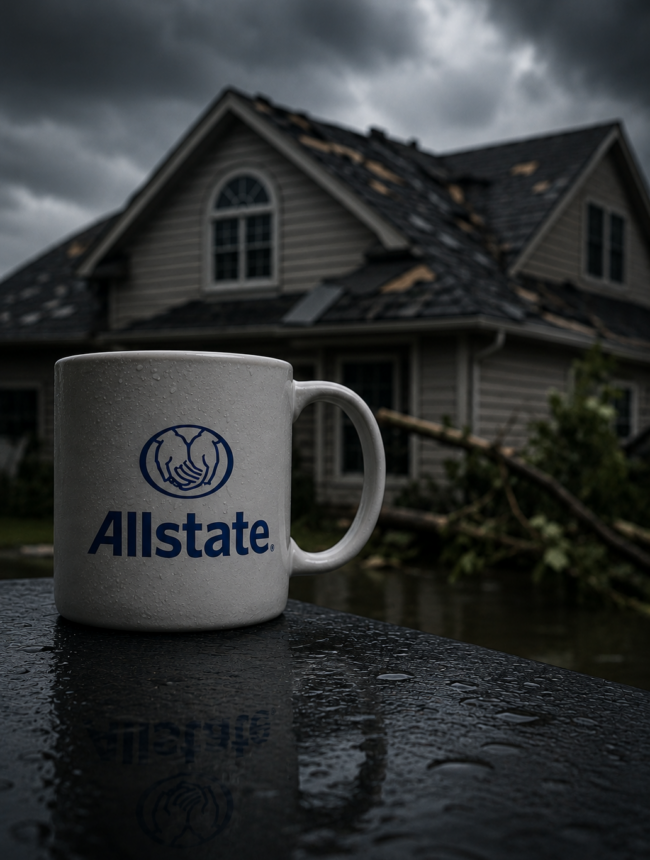
On July 7, Oklahoma Attorney General Gentner Drummond filed a lawsuit against Allstate Insurance Company, alleging the insurer ran a coordinated internal program to deny or underpay legitimate wind and hail damage claims from Oklahoma homeowners.
Filed in Cleveland County District Court, the Allstate lawsuit names the scheme the “Disaster Payment Minimization Scheme.” This is the second major insurance lawsuit Drummond has filed in 2 weeks — and it won’t be the last.
If you filed a storm damage claim with Allstate in Oklahoma and walked away feeling like you got less than you deserved, you may not have been imagining it. According to the AG’s petition, that outcome wasn’t an accident — it was the design.
The Scheme Described in Allstate Storm Damage Claims
The core allegation is straightforward and damning: Allstate marketed its homeowners policies as providing replacement cost coverage for storm damage, then allegedly used a hidden set of internal standards to pay out far less than policyholders were owed.
According to Drummond’s petition, the company did this through three specific mechanisms:
- Limiting field adjuster authority — the people who actually inspect your damage were reportedly stripped of the power to approve full payouts
- Relying on third-party inspectors and reviewers — outside contractors whose incentives aligned with minimizing claims, not honoring them
- Applying undisclosed internal standards — criteria that policyholders never saw and couldn’t challenge, because they didn’t know those criteria existed
The result, the lawsuit contends, was the systematic denial or underpayment of valid storm claims across the state.
Oklahoma homeowners already pay some of the highest insurance premiums in the country. They were paying full price for coverage that, according to the AG, Allstate had quietly hollowed out.
What the Incentive Structure Looks Like in Practice
Insurance companies make money two ways: collecting premiums and not paying claims. Every dollar that stays in the company’s pocket instead of going to a policyholder is, structurally, profit. That’s not a conspiracy theory — it’s accounting.
What the Oklahoma AG’s lawsuit alleges is that Allstate didn’t just benefit passively from this dynamic. The company allegedly built a formal internal program around it — complete with a name, the “Disaster Payment Minimization Scheme” — and a deliberate architecture designed to reduce payouts at scale. That’s the difference between an insurer that sometimes gets claims wrong and one that, according to the lawsuit, engineered the wrong outcome as a business strategy.
The lawsuit alleges violations of four separate legal theories:
- Oklahoma Consumer Protection Act — deceptive practices against policyholders
- Oklahoma RICO Act — the Racketeer Influenced and Corrupt Organizations statute, which signals the AG views this as an organized scheme, not isolated errors
- Civil conspiracy — coordinated action to harm policyholders
- Unjust enrichment — Allstate profited from money it allegedly should have paid out
Oklahoma is seeking injunctive relief, civil penalties, disgorgement of profits, and restitution for affected consumers.
Allstate Isn’t the Only Insurer in Oklahoma’s Crosshairs
This lawsuit didn’t arrive in a vacuum. Drummond filed a separate lawsuit against State Farm on June 24, 2026 — the day after the Oklahoma Supreme Court unanimously ruled he could not join an existing private lawsuit against that insurer and would need to file his own case. He did, within 24 hours. Both facts are documented in reporting by The Oklahoman.
Both lawsuits were filed in Cleveland County District Court. Both allege similar schemes to systematically reduce storm claim payments. Hundreds of private homeowner lawsuits against both companies were already pending in Oklahoma before the AG got involved.
The industry’s argument — that storm claims are complex, that adjusters sometimes disagree, and that not every reduced payout reflects bad faith — has merit as a general proposition. What it doesn’t explain is why a company would need a formal internal program with a name like “Disaster Payment Minimization Scheme” if the goal were simply accurate claims handling.
What Oklahoma Homeowners Should Do Right Now
If you had a wind or hail damage claim denied or reduced by Allstate in Oklahoma, this lawsuit is directly relevant to you. The state is seeking restitution for affected consumers — which means money could flow back to policyholders if the case succeeds.
There is no claim portal yet. The time to build your paper trail is now, before documents get harder to locate:
- Document your claim history. Pull every piece of correspondence from Allstate related to your storm claim — the initial estimate, any revised estimate, the denial letter or payment confirmation, and any adjuster reports you received. If you don’t have these, request them from Allstate in writing.
- File a complaint with the Oklahoma Insurance Department. The OID regulates insurer conduct in the state and tracks complaint patterns. Filing at oid.ok.gov creates a formal record and contributes to the regulatory picture. Your complaint may be relevant to the AG’s investigation.
- Contact the Oklahoma AG’s Consumer Protection Unit. Drummond’s office is actively litigating this. Consumer accounts of denied or underpaid claims are evidence. You can reach the AG’s consumer protection division at oag.ok.gov.
- Consult a licensed public adjuster. A public adjuster works for you — not the insurance company — and can independently assess what your claim was worth versus what you were paid. If there’s a significant gap, that documentation strengthens any future legal claim.
- Watch for class action filings. Given the scope of the AG’s allegations and the hundreds of existing private lawsuits, a class action against Allstate in Oklahoma is a realistic next step. You can track federal case filings through PACER at pacer.gov, or consult a consumer protection attorney about your eligibility.
The filing deadline for any restitution fund will depend on how the case resolves. Start gathering documentation now.
If Allstate denied or underpaid your Oklahoma storm damage claim, report it to the Oklahoma Insurance Department at oid.ok.gov — and tell us about it.
 Written by: Companies Behaving Badly
The team behind it all.
Been harmed by corporate negligence? Our legal partners can help you understand your rights and pursue justice.