

$725M Meta Privacy Litigation Settlement Checks: Round 2
Meta collected biometric data from hundreds of millions of Facebook users without their consent, building a facial recognition database that ran quietly for years. A class action lawsuit forced a…
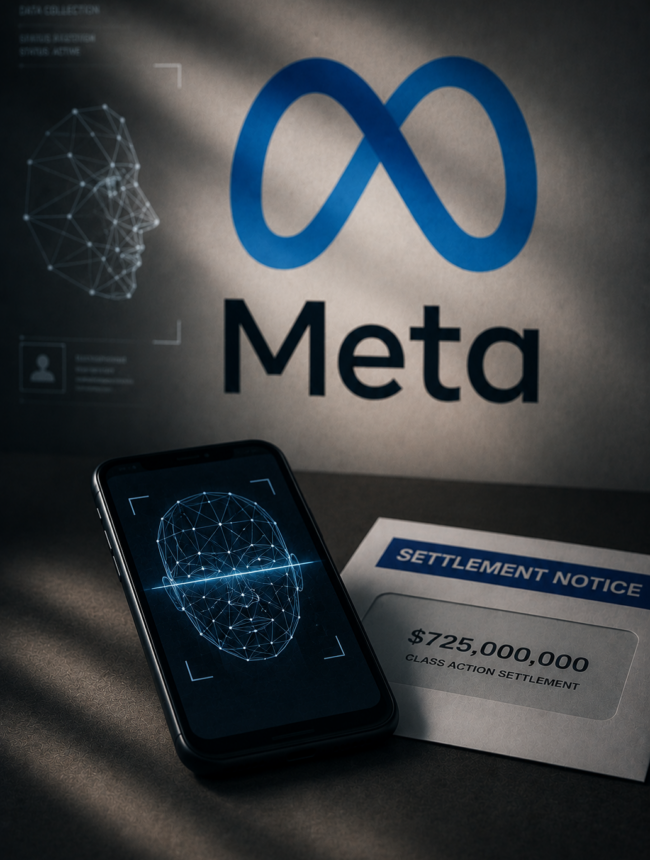
Meta collected biometric data from hundreds of millions of Facebook users without their consent, building a facial recognition database that ran quietly for years.
A class action lawsuit forced a $725 million settlement. The first round of checks went out in late 2025 — and a second distribution of roughly $100 million begins June 9, 2026.
If you used Facebook between May 2007 and December 2022 and filed a claim before the August 2023 deadline, you may be getting another check in the next few weeks.
If you never filed, your window has closed — but understanding what happened and why it only got fixed in one state is the part most coverage skips. You can also read about what makes Meta one of the worst social media companies.
About the Second Meta Privacy Litigation Settlement Checks
The short version: A lot of people left money on the table. After the first round of payments went out starting September 3, 2025, approximately 200,000 paper checks went uncashed. Another 3 million digital payments — sent via PayPal, Venmo, Zelle, or prepaid debit card — expired before recipients collected them.
That pool of unredeemed funds, totaling around $100 million, didn’t disappear. A U.S. court issued an order on May 6, 2026, approving a second distribution to redirect those funds back to class members who had already cashed their first payment. All of this is documented in the settlement’s official distribution FAQs.
The second distribution begins June 9, 2026, and will continue over the following 4 weeks. If your claim is approved for an additional payment, you’ll receive an email notification 3-4 days before the payment is issued.
The second-round payout is smaller than the first. The settlement FAQ puts the range at $4.67 to $7.32 per eligible claimant. The first distribution ranged from $4.89 to $38.36, depending on how long your account was active during the settlement period — 1 point per month the account was open, with a maximum of 188 points.
Most first-round checks averaged $29.43, according to reports.
How to Check Your Status Before June 9
If you filed a claim before the August 2023 deadline and cashed your first payment, here is what to do:
- Check your email for a message titled “Notice of Settlement Payment” — it will arrive three to four days before your payment is issued. Check your spam folder; these notifications have been landing there for many claimants.
- Log in to the settlement website to check your claim status and confirm your contact information is current.
- Verify your payment method — if you chose a digital option (PayPal, Venmo, Zelle, direct deposit, or prepaid debit card), confirm those accounts are still active and linked correctly. Expired digital payment methods were a primary reason the $100 million pool exists in the first place.
- Contact the administrator directly if something looks wrong. Email [email protected] with your claim ID number.
If you never filed a claim, the deadline passed in August 2023. According to LiveMint’s reporting, the settlement drew roughly 28 million claims filed, of which approximately 19 million were validated. If you weren’t among them, this round does not apply to you.
Why Illinois Gets a Payout, and Most of the Country Doesn’t
This entire case exists because Illinois passed the Biometric Information Privacy Act, known as BIPA, in 2008. BIPA requires companies to get explicit written consent before collecting biometric identifiers like facial geometry, fingerprints, or retinal scans — and it gives individuals the right to sue when that consent isn’t obtained.
No other state has a law with comparable private right of action and enforcement teeth.
Meta’s facial recognition system ran for years across its entire U.S. user base, and the technology:
- Scanned uploaded photos
- Mapped facial geometry
- Built a database that could identify individuals across images
Users in Illinois who were subjected to this without consent had legal recourse. Users in the other 49 states had essentially nothing. The settlement covered Facebook users in the United States broadly, but the legal engine driving it was Illinois law.
Without BIPA, this case likely never gets filed, never gets settled, and $725 million never changes hands. Meta, for its part, denied all claims and stated it did not violate any law — the settlement was reached, per the settlement website, “to avoid the costs and risks of a trial.”
That framing is worth sitting with. A company collects your biometric data without asking. It gets sued. It pays hundreds of millions of dollars. It still says it didn’t do anything wrong.
Meta’s Privacy Record Isn’t a Glitch — It’s a Pattern
This settlement doesn’t exist in isolation. The facial recognition case is one entry in a longer record of privacy enforcement actions against Meta, each following roughly the same arc: Collect data aggressively, settle when forced to, deny wrongdoing.
The fines are large in absolute terms. Relative to Meta’s revenue — which exceeded $160 billion in 2023 — they function more like a cost of doing business than a deterrent. The math works out fine for Meta and less fine for everyone whose face was in the database.
The incentive structure driving this is not complicated. Biometric data is extraordinarily valuable for advertising targeting and identity verification. Collecting it without consent costs nothing unless you get caught in a jurisdiction with a law that allows individuals to sue. Most jurisdictions don’t have that law.
So the rational calculation, from a pure business standpoint, is to collect broadly and settle narrowly when required. That’s not speculation — it’s what the settlement record shows.
The gap between Illinois and everywhere else is where the next large-scale data collection is already happening. If you want to push for broader protections: Contact your state legislators and ask whether your state has a biometric privacy law equivalent to Illinois’ BIPA.
If Meta collected your biometric data without your consent or otherwise harmed your family, tell us about it.
 Written by: Companies Behaving Badly
The team behind it all.
Been harmed by corporate negligence? Our legal partners can help you understand your rights and pursue justice.